Industrial Router: A Comprehensive Guide to Making the Right Choice
Definition, differences from a traditional router, 8 essential selection criteria for IIoT, SCADA, and remote access—everything a technical manager needs to know before equipping their industrial sites.
What is an industrial router?
Un industrial router is a network device designed to operate in demanding environments—production facilities, electrical cabinets, outdoor sites, and hazardous areas. Unlike standard consumer or business routers, it incorporates hardware and software features specific to industrial applications: serial communication protocols (RS-232, RS-485, Modbus), extended temperature ranges, wide-range power supplies, industrial certifications, and redundancy mechanisms.
Industrial Router vs. Consumer Router
8 Essential Criteria for Choosing Your Industrial Router
Operating temperature range
Determine the minimum and maximum temperatures inside your electrical cabinet. In an outdoor cabinet exposed to the sun in the summer, the temperature can exceed 60°C. In a cold storage area, it can drop below -20°C. Choose a router certified to operate beyond these extreme values.
Mounting Format and Dimensions
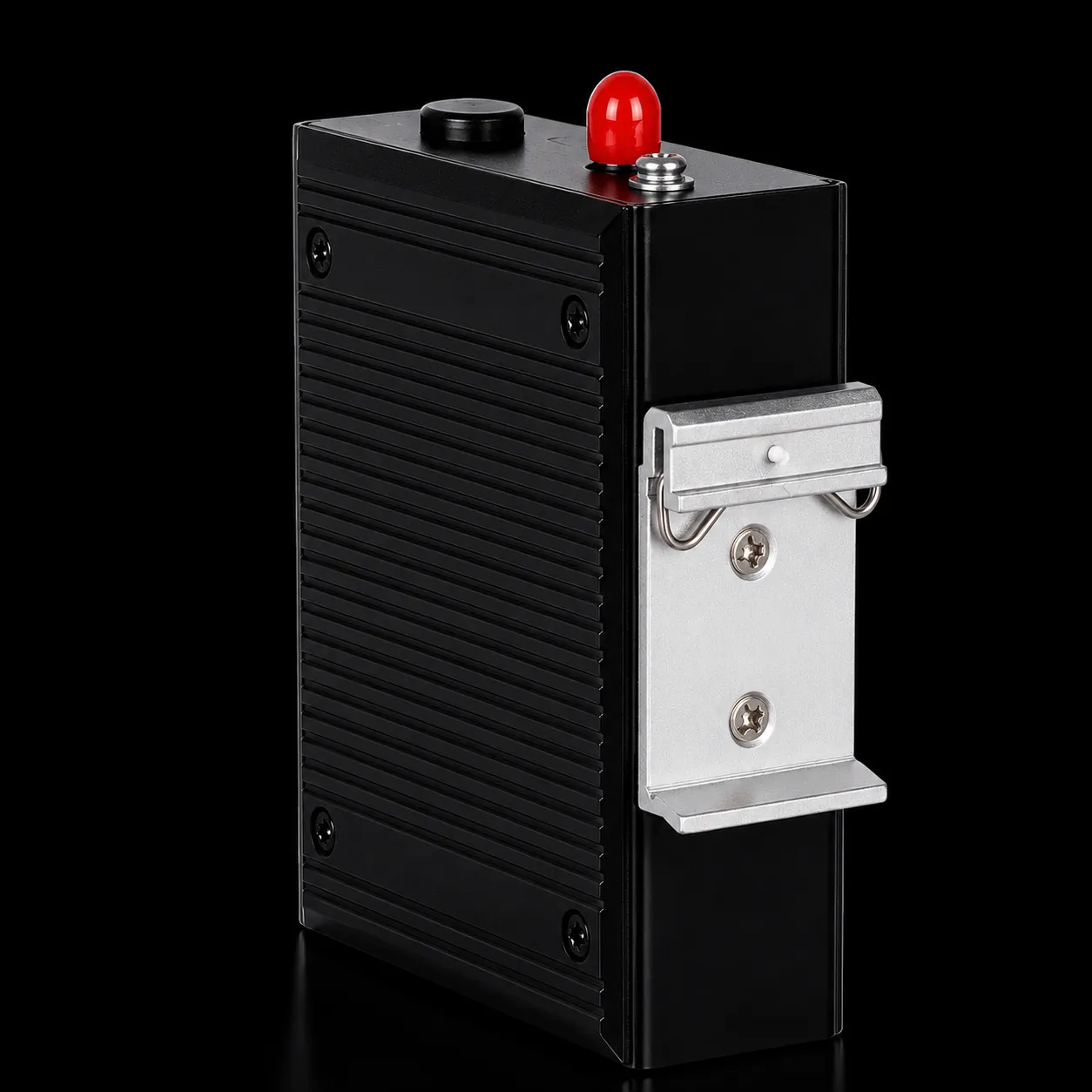
The 35mm DIN rail is the industry standard. Check the available space in your cabinet. A compact size such as 102×33mm allows you to install the router without modifying the existing wiring.
Connection Redundancy (Dual SIM)
For a mission-critical site, Dual SIM with automatic failover is essential. In the event of a network outage with the primary carrier, the switchover must be transparent to applications—typically within 8 to 30 seconds.
Supported Industrial Protocols
List the devices to be connected. Modbus RTU controllers require an RS-485 port. Energy meters may use Modbus TCP or M-Bus. Make sure the router natively supports these protocols without requiring an additional gateway.
Security and VPN
For remote access to OT equipment, an integrated VPN is required. Choose OpenVPN (high performance, simplified configuration) or IPSec (maximum interoperability). Verify compliance with NIS2 and IEC 62443 for critical infrastructure.
Centralized Management and Zero-Touch Provisioning
For deployments involving dozens or hundreds of sites, Zero-Touch Provisioning (ZTP) saves a considerable amount of time. Remote firmware updates (OTA) eliminate the need for on-site visits to keep the fleet up to date.
Food and Consumption
A wide-range power supply (typically 9–36 V DC) allows you to connect the router directly to the 24 V DC bus in your cabinet. Choose low-power equipment (< 5 W) for battery- or solar-powered sites.
Certifications and Regulatory Compliance
CE and FCC certifications are required for sale in Europe and the U.S. RoHS certification guarantees that the product is free of hazardous substances. For environments with a risk of explosion, check for ATEX or IECEx certifications.
Supported Industrial Protocols
The Eziwan Gateway natively supports the main industrial protocols without requiring any additional modules.
Standard asynchronous serial interface for point-to-point communication. Data rate up to 230 kbps. Compatible with most PLCs and measuring instruments.
Multi-point differential serial bus for industrial networks. Up to 32 devices on the same bus, with a range of 1,200 meters. De facto standard for Modbus in industry.
The most widely used industrial communication protocol. Binary mode over RS-485 for reading and writing registers in PLCs, counters, and variable-speed drives.
Modbus protocol encapsulation over Ethernet/IP. Enables modern PLCs on an Ethernet local area network to connect directly to the cloud.
A lightweight publish/subscribe protocol for industrial IoT. Persistent connection with configurable QoS (0/1/2), automatic reconnection, compatible with AWS IoT, Azure IoT Hub, and HiveMQ.
Interoperable IIoT communication standard for SCADA and MES. Secure architecture with authentication, object information model, and automatic node discovery.
Industrial Routers by Industry
From local governments to large industrial corporations, industrial routers connect all sites.
Water & Sanitation
Monitoring of pumping stations, wastewater treatment plants, and water towers in rural areas. Modbus RTU transmission of water levels, flow rates, and overflow alarms. Compliance with the Environmental Code.
Energy & Smart Grid
Remote meter reading for energy meters, monitoring of high-voltage and medium-voltage substations, and monitoring of storage batteries. IEC 61850 and Modbus TCP protocols for renewable energy.
Manufacturing Industry
Real-time production data collection, remote access to Siemens/Schneider PLCs, predictive maintenance. Replacement of end-of-life 2G GPRS connections.
Agriculture & Irrigation
Management of irrigation pumps, soil sensors, and weather sensors on the farm. Connectivity in areas with poor network coverage using multi-carrier SIM cards to maximize availability.
Construction & Temporary Work Sites
Deployment of temporary sites without fixed network infrastructure. Zero-Touch Provisioning for rapid deployment. Easy relocation from one site to another.
Infrastructure & Mobility
Monitoring of road infrastructure, traffic signals, and surveillance cameras. Redundant connectivity with automatic failover for public safety systems.
The Eziwan Gateway — the all-in-one industrial router
Designed to meet all the selection criteria described in this guide, the Eziwan Gateway integrates everything an industrial infrastructure needs into a compact DIN-rail enclosure: 4G LTE Cat.4, dual SIM failover, RS-485, OpenVPN/IPSec VPN, zero-touch provisioning, and cloud monitoring.
Frequently Asked Questions
Take action
Now that you have all the criteria, find out how the Eziwan Gateway meets them—or contact our team for an audit of your needs.